
In der Welt der produzierenden Industrie macht Qualität den Unterschied zwischen Erfolg und Misserfolg. In einer Branche, die von steigendem Wettbewerb und anspruchsvollen Kunden geprägt ist, ist ein effektives Qualitätsmanagement unerlässlich. Wie können produzierende Industrieunternehmen sicherstellen, dass sie Produkte von höchster Qualität liefern und gleichzeitig effizient und profitabel arbeiten? Und was ist ein Qualitätsmanagementsystem? Tauchen Sie ein in die Welt der Qualitätsstandards, Prozessoptimierung und kontinuierlichen Verbesserung und erfahren Sie, wie Sie Ihre Produktionsabläufe revolutionieren, Fehler minimieren, Ausschuss reduzieren und Verschwendung eliminieren können. Effektives Qualitätsmanagementsystem führt nicht nur zu Kosteneinsparungen, sondern stärkt auch das Vertrauen Ihrer Kunden und verschafft Ihnen einen Wettbewerbsvorteil.
Contents
- What Is Quality Management?
- ISO 9000: The 7 Principles of Quality Management
- How is quality defined?
- Quality Management Responsibilities
- What are the objectives of quality management?
- What are the advantages and disadvantages of quality management?
- Quality Management vs. Quality Assurance
- Quality Management at a Glance
Definition: What Is Quality Management?
Quality management is a structured approach aimed at ensuring and continuously improving the quality of products, services, and processes within a company. By establishing quality standards, training employees, monitoring performance, and implementing quality controls, errors can be minimized and customer requirements met. An effective quality management system helps increase customer satisfaction, strengthen competitiveness, reduce costs, and foster a positive corporate image.
ISO 9000: The 7 Principles of Quality Management
The ISO 9000 standard, the ISO standard for quality management, defines the seven principles of quality management, which serve as the foundation for effective quality management systems.
These principles are:
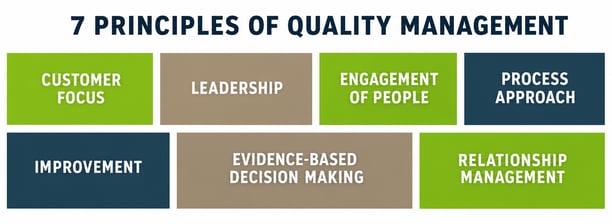
- Customer Focus: Customers are at the heart of quality management. The goal is to understand their needs, expectations, and requirements and to consistently meet or exceed them in order to ensure customer satisfaction.
- Management Responsibility: Managers are responsible for formulating a clear vision and goals and steering the company toward quality and excellence. They create an environment in which employees are motivated, inspired, and empowered to do their best.
- Involvement of All Stakeholders: The involvement and empowerment of all employees are crucial to the success of quality management. Each individual contributes their expertise, experience, and skills to support continuous improvement and promote quality at all levels.
- Process-oriented approach: Business processes are viewed as an interconnected system. This means that the planning, implementation, and monitoring of activities are based on processes. This allows for increased efficiency and effectiveness, as the interactions between processes are taken into account.
- Continuous Improvement: The pursuit of continuous improvement is a core principle of quality management. Companies should regularly monitor, measure, and evaluate their performance, processes, and products to identify weaknesses and implement targeted improvement measures.
- Fact-Based Decision-Making: Decisions should be made based on solid data and reliable information. Facts and data provide the foundation for well-informed decisions to minimize risks, capitalize on opportunities, and evaluate the effectiveness of measures.
- Mutually Beneficial Supplier Relationships: Collaboration with suppliers and other relevant partners is of great importance. A partnership-based relationship enables the efficient exchange of information, the joint development of solutions, and the building of trust, ultimately creating a win-win situation.
These principles serve as a guide for companies to develop and continuously improve their quality management systems. By putting these principles into practice, companies can enhance their quality, increase customer satisfaction, reduce costs, improve efficiency, and strengthen their competitiveness.

How is quality defined?
💡Definition: Quality means that products and services meet the expectations of customers, users (consumers/producers), retailers, and manufacturers. The goal is to ensure that products and services meet individual needs, preferences, and expectations.
In general, quality refers to the degree of excellence, perfection, or goodness of a product, service, or process. Quality can be defined both subjectively and objectively:
Subjective Quality
Subjective quality refers to a person’s individual perception and evaluation. A product or service is subjectively perceived as high-quality if it meets a person’s individual needs, preferences, and expectations and provides a positive experience or satisfaction.
Objective Quality
Objective quality refers to the measurable and verifiable characteristics and properties of a product, service, or process. It is based on specific criteria, standards, and specifications. Objective quality can be determined through inspections, tests, measurements, and other objective evaluation methods. A product or service is objectively considered to be of high quality if it meets the established quality standards, is free of defects, functions reliably, and conforms to the specified requirements.
Quality Management Responsibilities
Quality management involves a wide range of tasks aimed at ensuring and continuously improving the quality of products, services, and processes. Below are some key tasks that quality management encompasses:
Process Optimization
Quality management analyzes existing business processes, identifies opportunities for improvement, and develops strategies for optimization. Process analysis and process documentation are key tools for process optimization. Efficient and effective processes are designed to enhance quality, minimize errors, shorten lead times, and reduce costs.
Planning and Implementation of the QMS
Quality management is responsible for planning and implementing the quality management system (QMS) within the company. This includes setting quality objectives, developing quality policies and procedures, defining responsibilities, and establishing measures for monitoring and controlling quality.
QM Documentation
Quality management creates and manages QM documentation. This includes the creation of quality policies, standard operating procedures, work instructions, test plans, reports, and other relevant documents that define the standards and requirements of the QMS.
Quality Assurance
Quality management monitors the quality of products, services, and processes to ensure they meet the defined quality standards. Tests, inspections, and audits are conducted to verify compliance with quality requirements and to identify potential deviations or errors.
Continuous Improvement
Quality management promotes a culture of continuous improvement. Measures are taken to analyze weaknesses, identify the causes of errors, and implement appropriate measures for error prevention and correction. Continuous improvement is pursued through the use of quality methods such as Six Sigma, Lean Management, or the PDCA cycle (Plan-Do-Check-Act).
Training
Quality management organizes training sessions for employees to promote quality awareness and provide the necessary expertise to implement quality standards. Training programs are developed that are tailored to the company’s specific requirements.
What are the objectives of quality management?
Quality management pursues a variety of objectives to improve the quality of products, services, and processes and to increase customer satisfaction.
Below are some key objectives of quality management:
Increasing customer satisfaction
A central objective of quality management is to understand and meet customer expectations and needs. Providing high-quality products and services that meet customer requirements increases customer satisfaction.
Improving product quality
Quality management strives to continuously improve product quality. This includes reducing errors, defects, and nonconformities to ensure that products meet specified quality standards and satisfy customer requirements.
Increasing Efficiency
By implementing effective quality management processes and methods, quality management aims to improve process efficiency. By optimizing workflows, reducing waste, and preventing errors, productivity and efficiency are increased.
Error Prevention and Correction
Quality management aims to detect and prevent errors early on. By implementing quality controls, monitoring procedures, and preventive measures, potential causes of errors can be identified and the error rate reduced before they affect product quality.
Improving Supplier Relationships
Quality management strives for close collaboration with suppliers to ensure continuous quality improvement throughout the supply chain. Good cooperation, communication, and coordination with suppliers ensure a reliable and high-quality supply of materials and components.
Compliance with Standards and Regulations
Quality management strives for close cooperation with suppliers to ensure continuous quality improvement throughout the supply chain. Good cooperation, communication, and coordination with suppliers ensure a reliable and high-quality supply of materials and components.
What are the advantages and disadvantages of quality management?
Quality management offers a variety of advantages and disadvantages that should be taken into account during implementation and maintenance.
A significant advantage of quality management is improved product quality. By introducing quality standards, monitoring, and control mechanisms, errors and defects are detected and corrected early on. This increases product quality, leading to higher customer satisfaction and an improved corporate image.
Customer Satisfaction
Another advantage is increased customer satisfaction. By focusing on customers’ needs and expectations, products and services can be specifically tailored to meet them. Customer-oriented processes, quick response times, and customized solutions help build long-term customer loyalty and strengthen competitiveness.
Quality management enables increased efficiency. By analyzing and optimizing processes, waste and inefficiencies can be reduced. This lowers costs, increases productivity, and shortens delivery times. As a result, the company’s profitability improves.
Continuous Improvement and Innovation
Another benefit lies in continuous improvement. Quality management fosters a culture of continuous improvement and innovation. Through regular review of processes, employee involvement, and the implementation of improvement measures, the goal is to achieve sustainable development.
Despite the advantages, there are some challenges and potential drawbacks to quality management. Implementation requires time, financial resources, and employee commitment. Clear structures and responsibilities must be established to ensure successful implementation.
Employee Training
Furthermore, the complexity of quality management can pose a hurdle. Employees require thorough training and support to build the necessary knowledge and skills. Additionally, standardization and bureaucratic processes can lead to a certain degree of restriction on flexibility and creativity.
Ultimately, however, quality management is a vital component for companies to strengthen their competitiveness, satisfy customers, and increase operational efficiency. Through targeted planning, clear communication, and continuous improvement, the benefits of quality management can be successfully leveraged.
Quality Management vs. Quality Assurance
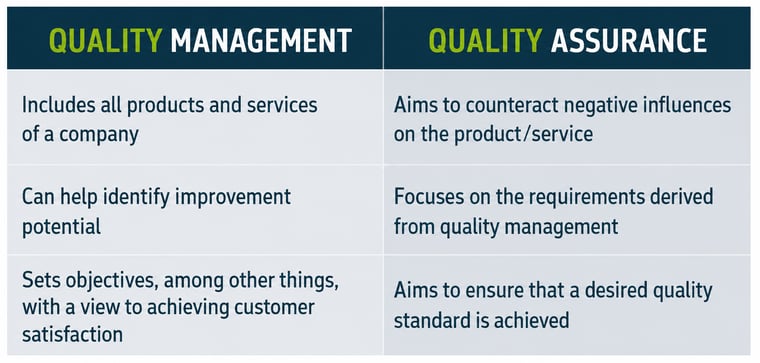
Quality management (QM) refers to the strategic organization and control of all quality-related activities within a company in order to optimize and continuously improve quality. It encompasses the planning, implementation, and monitoring of processes, policies, and training to meet quality standards and increase customer satisfaction.
Quality Assurance (QA), on the other hand, focuses on specific measures to verify, control, and ensure the quality of products or services. This includes establishing quality standards, conducting inspections, tests, and audits, as well as managing nonconformities and implementing corrective actions. Quality assurance software supports these measures and paves the way toward the Smart Factory.
QM and QA complement each other to ensure comprehensive quality assurance and meet customer expectations.
Quality Management at a Glance
Quality management refers to the strategic organization, control, and optimization of all quality-related activities within a company. The main goal is to offer high-quality products and services in order to meet customer requirements and increase customer satisfaction. This involves planning, implementing, and monitoring processes to continuously improve quality. In addition, employees are actively involved, and data is used to inform decision-making. Through effective quality management, companies can strengthen their competitiveness, reduce costs, increase efficiency, and gain customer trust. It is the key to success in an increasingly demanding business environment.
FAQ
How can I continuously improve my quality management?
To continuously improve your quality management, you can use customer feedback, conduct internal audits, train employees, establish a culture of continuous improvement, and utilize quality management tools.
What role do audits and certifications play in quality management?
Audits and certifications play an important role in quality management because they enable an independent review and evaluation of your processes and systems. They help identify weaknesses, confirm compliance with quality standards, and strengthen the trust of customers and business partners.
How do I set up a quality management system in my company?
To implement a quality management system in your company, you should define a clear quality policy, set goals, document processes, assign responsibilities, and implement a suitable management system, such as ISO 9001. Training, communication, and regular reviews are also important.
How can I integrate quality management into my processes?
Quality management can be integrated into your processes by establishing quality objectives and standards within them. Quality assurance steps, such as random inspections or error-prevention measures, can be implemented. Regular monitoring, measurement, and analysis of process performance help ensure quality and identify opportunities for improvement.
Leave a comment