
In production, quality control determines whether the manufactured products meet both the company’s own and statutory quality standards. If products pass internal quality controls, this has a positive impact on customer satisfaction, as customers receive the product they have purchased in the quality they have come to expect. In this article, we show you how to optimise your production using quality controls.
Contents
- What is quality control?
- Quality control tasks
- Quality Control vs. Quality Assurance vs. Quality Management
- Quality is the key to success
- Basic Principles of Quality Control
- Common methods of quality control
- Do you already have a quality control system in place?
What is quality control?
Quality control (QC) takes place during and after production and forms part of a company’s quality management system. In manufacturing processes, its aim is to ensure that the manufactured products comply with predefined standards and requirements. This systematic monitoring and testing is carried out through visual inspections, metrological procedures and modern technologies such as sensors and data analysis. Modern quality assurance software supports manufacturers in quality analysis, control and assurance.
Production and Services
Quality control methods exist for both the manufacture of goods and the assessment of services. As with the production of goods, service standards are drawn up in advance. During the control process, checks are then carried out to ensure that these standards are being met.
Quality control tasks
The role of quality control is to identify faults or defects before products are released onto the market. The consistent application of quality control processes ensures the consistency and reliability of products, strengthens customer confidence, increases customer satisfaction and has a positive impact on companies’ competitiveness.
Differences between Quality Control, Quality
Assurance and Quality Management
All three measures help companies to achieve their quality objectives. Quality management is the overarching approach that integrates quality assurance and quality control. The aim is to ensure that products are manufactured to the desired product quality. This reduces the scrap rate and has a positive impact on sustainability in production.
Quality Management |
Quality Assurance |
Quality Control |
|
|
|

Quality is the key to success
Quality control is regarded as a crucial factor in production and service processes. It ensures compliance with quality standards and has an impact on overall business performance. In production environments, quality control measures identify defective products and provide information on the causes of deviations. Subsequent process controls and process analyses drive process optimisation. This enables companies to organise their production chains more efficiently, use resources sustainably, satisfy customers and drive their own business success.
Technology and Smart Factories
Modern equipment, inspection systems and software support quality control. Interconnected smart factories handle some of this automatically. Through real-time analysis, the data generated during production immediately flags any deviations in quality. Furthermore, the data is ideal for root cause analysis and fault management.
Loss of trust due to poor quality
If product quality is not up to standard, companies pay the price in terms of their customers’ trust. As well as complaints or product recalls, the company’s image can suffer long-term damage. Financial losses and reduced competitiveness are the consequences of poor quality and inadequate quality controls.
Basic Principles of Quality Control
Quality control follows a structured process and begins with the establishment of quality standards. This involves defining specifications, tolerances and acceptance criteria. During production or the provision of services, systematic monitoring is carried out through visual inspections, metrological procedures and the use of modern technologies. Any deviations identified lead to corrective actions, whilst regular audits and training ensure the effectiveness of quality control.
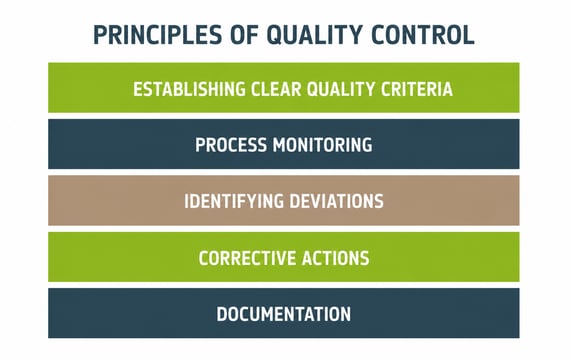
Establishing quality standards
Define clear and measurable criteria against which you can assess and measure quality. Make use of industry-specific standards, customer specifications, statutory regulations or internal quality guidelines.
Monitoring production or the process
Regularly monitor production operations or individual process steps to ensure that the defined quality standards are being met. Take random samples, carry out measurements or conduct visual inspections.
Identification of deviations or defects
Compare the results achieved with the quality standards to identify deviations or defects. These may include, for example, dimensional deviations, defective components, manufacturing defects or other quality issues.
Corrective actions
Take appropriate measures to restore quality where deviations have been identified. This may include the repair or reworking of products, adjustments to processes, or training for staff.
Documentation and reporting
Document all quality control activities carried out, any deviations identified, the corrective actions taken, and the results achieved. This serves to ensure traceability, enable trend analysis, and facilitate continuous quality improvement.
Digital quality control
Werden moderne Technologien im Bereich der Qualitätskontrolle implementiert, fällt die manuelle Verwaltung von Papierdokumentationen und somit auch menschliche Fehler weg. Die automatisierte und digitale Erfassung der Dokumente ermöglichen einen einfachen, standortunabhängigen Zugriff, verbessern die Nachverfolgbarkeit von Daten und erlauben automatisierte Workflows. Zudem erlaubt die digitale Dokumentation der Qualitätsdaten eine leichtere Datenanalyse, mehr Datensicherheit und Compliance.
Common methods of quality control
Inspection: Visual or optical quality control involves assessing the product for defects, faults, contamination or deviations from quality standards, either through manual inspection or using technical aids such as cameras or inspection systems.
Sampling: An efficient method of checking large production batches by selecting and testing a representative sample, either at random or according to specific criteria.
Tests and measurements: Carrying out quantitative measurements or performance tests to ensure that the product meets specified requirements, e.g. dimensional checks, strength or load tests, electrical tests, chemical analyses.
Seamless weight control: Dynamic scales such as the checkweigher check within the production line whether the required weights are being met and automatically sort out products that do not meet the quality criteria.
Process control: Monitoring of the production process through regular sampling and analysis to ensure that the process complies with quality standards.
Fault and root cause analysis: Identification of defects and determination of their causes using various methods such as Six Sigma or Paka Yoke.
Documentation: Careful documentation of all activities and results to ensure traceability, verifiability and long-term analysis.
Continuous improvement: Using quality control not only to detect defects, but also to identify potential for improvement in the production process by analysing the results.
Do you already have a quality control system in place?
If not, you should do so as a matter of urgency, as quality control has a positive impact on the products manufactured and on the company as a whole. It identifies faulty products and the causes of deviations. Using modern technologies and equipment, you can collect data from your production processes and actively use this data to improve your products and production processes. This leads to efficient and resource-efficient production, as well as profitable and sustainable business practices.
FAQ
How can technology help to improve quality control?
Technology improves quality control by utilising advanced sensors, automated inspection systems and data analysis tools to enable more precise and efficient monitoring and fault detection processes.
What impact does quality control have on customer satisfaction?
Quality control has a positive impact on customer satisfaction as it ensures that products or services meet the specified standards. It minimises defects and thereby strengthens confidence in the brand’s quality.
What risks arise from inadequate quality control?
Inadequate quality control carries the risk of defective products being released onto the market. This can lead to customer dissatisfaction, complaints and potential legal consequences. In the worst-case scenario, the company’s entire reputation may suffer, resulting in financial losses.
Leave a comment